
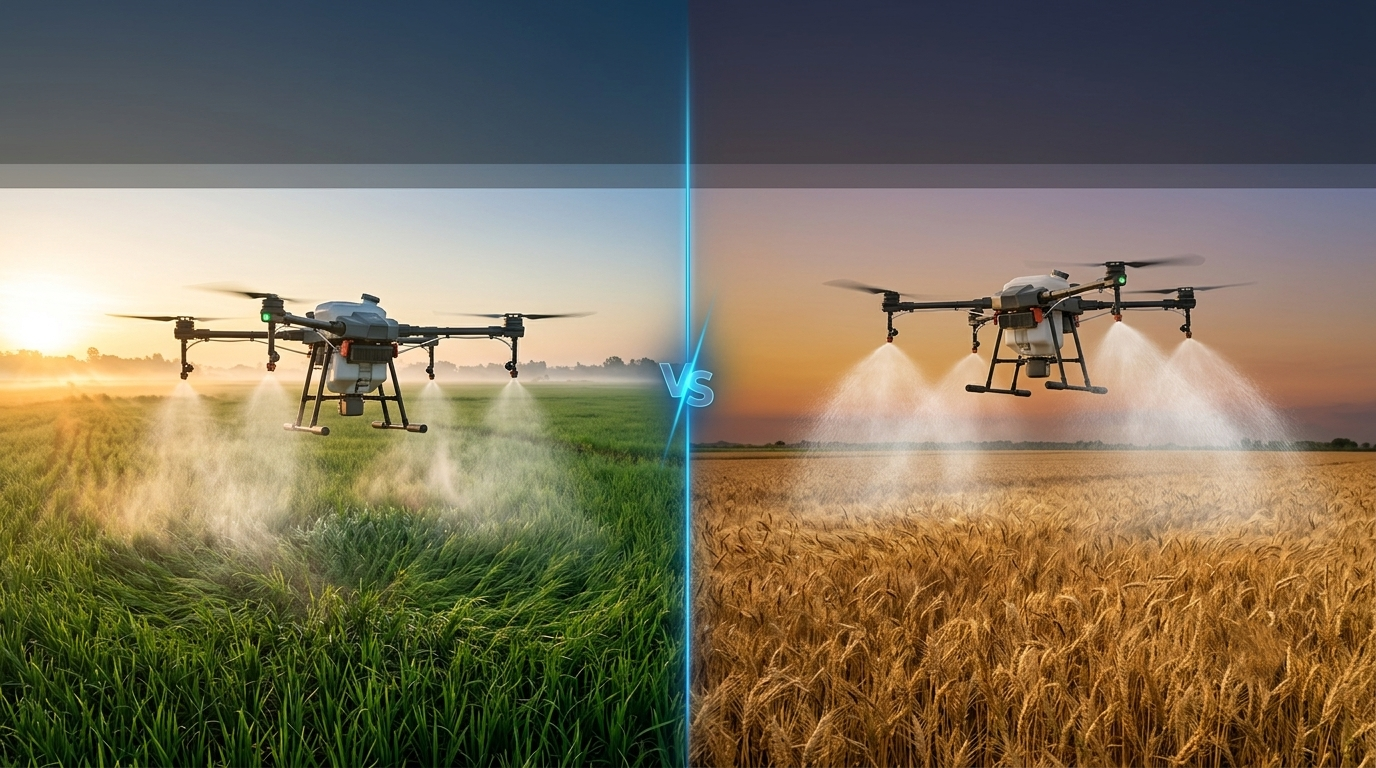
DJI's Agras line is built to make precision agriculture practical at Indian farm scale, and the T70P and T100 are the two workhorses most farm operators end up comparing. Both spray, spread and lift — the difference is how much, and for what size of field.
The short version
The Agras T70P is built for medium-sized farms and fields that need frequent turns. The Agras T100 is the bigger sibling, built for large, straight fields where you want maximum coverage per flight with fewer refill stops.
Tank capacity
The T70P carries a 70-litre spray tank. The T100 steps up to 100 litres. That 30-litre difference matters most on large, uninterrupted plots — more tank means fewer landings to refill, which adds up over a full day of spraying.
Payload across every mode
- Agras T70P: up to 70L spraying, 100L spreading, or 65kg for lifting operations.
- Agras T100: up to 100L spraying, 150L spreading, or 80kg for lifting operations.
If your operation mixes spraying season with granular fertiliser spreading, the T100's higher ceiling on both fronts gives you more headroom before you're maxed out.
Flow rate
Both drones use the same dual-sprinkler system rated around 30L/min, with an optional four-sprinkler upgrade pushing that to roughly 40L/min. So the spraying speed itself is comparable — the real difference between the two machines comes down to how much liquid each one can carry before it needs to land.
Which farm size fits which drone
Think of the T70P as the versatile choice: lighter, easier to manoeuvre around irregular plots, orchards, or fields with a lot of turning. The T100 is the specialist for scale — large, open, geometrically simple fields where you want to cover maximum hectares per battery cycle without constantly turning back.
Making the call
Not sure which one fits your acreage and crop mix? Talk to our agriculture drone team — we'll walk through your field layout and spray schedule before you commit to either machine.