
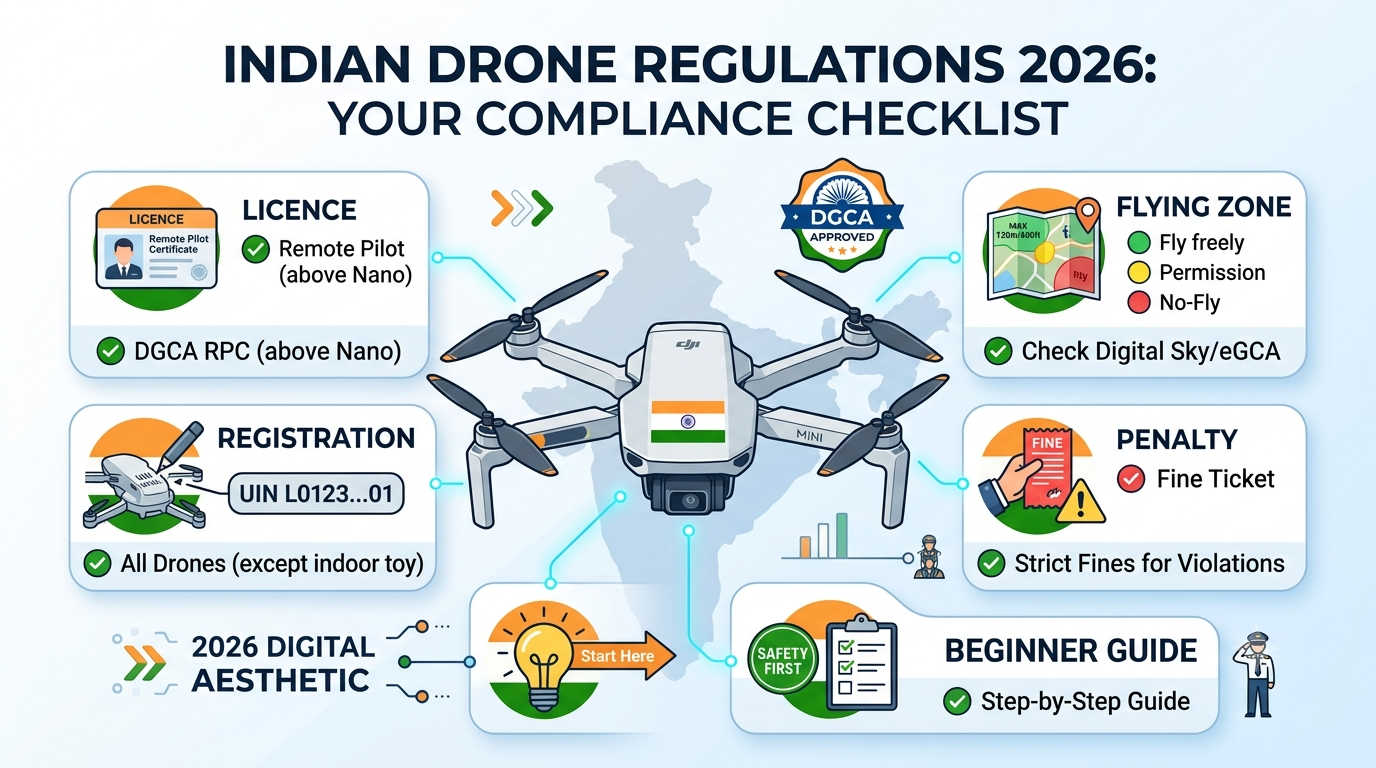
Buying your first drone in India comes with one question every serious buyer eventually asks: what am I legally allowed to fly, and what paperwork do I need? The rules aren't complicated once you know which category your drone falls into. Here's the current picture for 2026, straight from the Drone Rules 2021 framework that still governs flying in India today.
Which category does your drone fall under?
The Drone Rules 2021 sort every unmanned aircraft by weight, and your category decides almost everything else — registration, licensing, and where you can fly.
- Nano — up to 250g. No registration and no pilot licence needed for non-commercial flying.
- Micro — 250g to 2kg.
- Small — 2kg to 25kg.
- Medium — 25kg to 150kg.
- Large — above 150kg.
This is exactly why sub-250g drones like the DJI Mini 5 Pro and DJI Mini 4 Pro are so popular with first-time buyers in India — they sit in the Nano category, which means recreational flyers can be airborne without registration paperwork.
Registering your drone on Digital Sky
Anything above Nano weight needs to be registered on the government's Digital Sky platform, where it's issued a Unique Identification Number (UIN). This applies whether you're flying for photography, mapping, or enterprise work. Import of fully-assembled drones is restricted under current policy — only components can be freely imported — which is part of why type-certified, India-compliant models matter when you're buying.
Do you need a Remote Pilot Certificate (RPC)?
If you're operating a Micro, Small, Medium or Large category drone commercially, you need an RPC. Nano drones flown for personal, non-commercial use are exempt. As of 2026, India has more than 38,500 registered drones, close to 40,000 DGCA-certified remote pilots, and 244 approved Remote Pilot Training Organisations (RPTOs) issuing licences nationwide — so getting certified has never been more accessible if your work needs it.
The NPNT rule and no-fly zones
No Permission, No Takeoff (NPNT) is strictly enforced for every drone above Nano category. In practice, this means your drone checks in digitally before every flight and won't launch in restricted airspace without clearance. Airports, border areas, and certain government installations remain no-fly zones regardless of category.
What's changing: the Civil Drone Bill 2025
In September 2025, the Ministry of Civil Aviation introduced the draft Civil Drone (Promotion and Regulation) Bill, 2025 — a new law that will eventually replace the Drone Rules 2021 entirely. It introduces stricter enforcement, including fines of up to ₹1 lakh and imprisonment for serious violations.
What this means when you buy from HobiTech
Every drone we sell is a genuine, DGCA-type-certified DJI model, which keeps you on the right side of import and registration rules from day one. If you're a hobbyist, the sub-250g Nano-category models are the simplest route — no registration, no licence, just fly. If you're buying for commercial or enterprise work, our team can walk you through what registration and licensing you'll actually need for your specific use case.
Have questions about which category your next drone falls into? Get in touch with our team or browse our full range in the shop.