
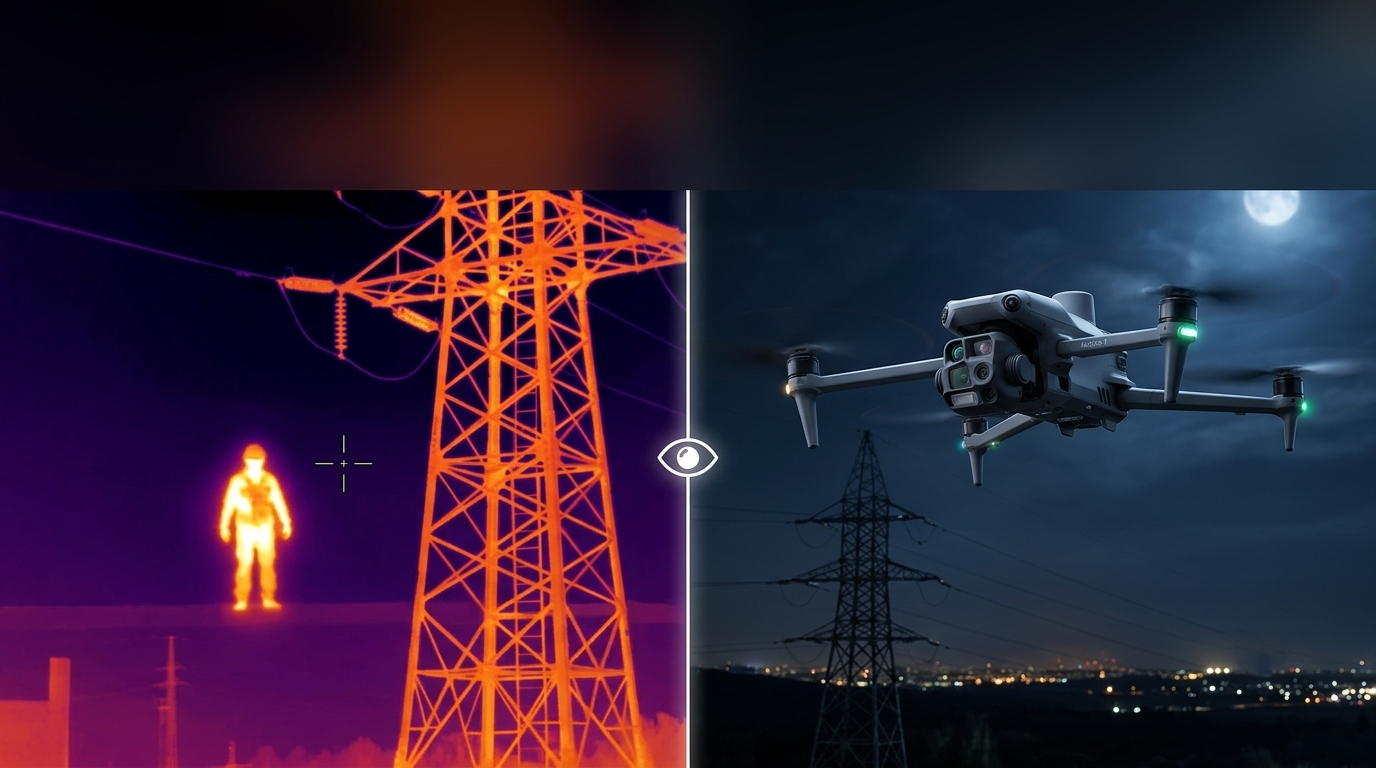
Thermal imaging turns a drone from a camera in the sky into a diagnostic tool — one that sees heat instead of just light. For inspection, search and rescue, and security work, that's often the difference between spotting a problem and missing it entirely.
How thermal imaging actually works
A thermal sensor doesn't record visible light — it records infrared radiation and converts it into a radiometric image, meaning every pixel carries an actual temperature value, not just a colour representing "hotter" or "cooler." That distinction matters: a radiometric thermal drone can tell you a transformer is running at 78°C, not just that it looks warm.
What the DJI Matrice 4T brings to the table
The DJI Matrice 4T pairs a 640×512 native thermal sensor (12μm pixel pitch, 30Hz frame rate) with a Super Resolution mode that upscales to 1280×1024 for sharper detail on distant targets. Its 45° field of view and f/1.0 aperture keep the image bright even in low light, and it measures temperature across two ranges: -20°C to 150°C in high-gain mode, and 0°C to 550°C in low-gain mode — wide enough to cover everything from a person in the dark to an overheating electrical fault.
Infrastructure and industrial inspection
Power line and substation inspection is one of the most common thermal use cases — a loose connection or failing component runs hotter than it should well before it fails visibly. The same logic applies to solar farm inspection, where a single underperforming panel shows up immediately as a thermal anomaly across an array that would take hours to check panel-by-panel on foot.
Search, rescue and public safety
In search and rescue, thermal is often the only practical way to locate a person in dense vegetation, at night, or across a large search area — body heat stands out against a cooler background even when there's no visual line of sight. The same capability supports law enforcement overwatch and perimeter security, where seeing what's moving in the dark matters more than seeing what it looks like.
Beyond the obvious: building and wildlife applications
Thermal cameras are also used to check building insulation (heat escaping through a poorly sealed roof or window shows up instantly), scan a site for persons after hours, and support wildlife monitoring and forestry conservation work where animals need to be located without disturbing them.
Getting started with thermal inspection
If your work involves infrastructure inspection, security, or search and rescue, the Matrice 4T is worth evaluating against your specific range and resolution needs. Talk to our enterprise team about a demo, or see full specifications on the DJI Matrice 4T product page.